Monday, September 13, 2010

Fear and Trembling….and Parenting Through It….


So lately my former student/blog commentator/texter extraordinaire Don Miller has been responding like crazy to one of my posts. But really, he’s not responding: he’s addressing a whole new topic, and one that deserves some attention: bullying, and our attempts to eliminate it. But in his posts and private emails to me, he’s getting at a much larger set of issues: the role that parents have in protecting their children from outside menaces. This takes many forms, but personal harassment is certainly one of them. Don’s questions—about whether we take things too far in trying to protect our children from harm—get at a central problem that we as parents face: what does it mean to protect our children? Can it be taken too far?

I have read a number of articles that suggest that we definitely do take our protection too far, and that it has a number of dire consequences for our kids. Back in 2004 I read—and passed on—an article by Hana Estroff Marano that was published in Psychology Today, “A Nation of Wimps.” Marano’s claim is that our over-protective parenting was producing a nation of spineless children. I have given this article to many of my students, who understand where she’s coming from: many of them are the victims of excessive parenting (at the hands of kind and very-well-intentioned mothers and fathers). So there is a problem, or a potential one. At the same time, every parent wants to protect children. What to do?

As strange as it may seems, I believe that what we parents and teachers need most is to protect and love our children more—not less. Come again? Yes; we need to understand that part of protecting our children is trying to equip them thoroughly with what they need to go through life, not just trying to keep them from getting hurt but helping them work through the hurt, trusting that there is something good at the other end of that pain. We will not keep them from the many faces of pain; the real question is how we can help them deal with suffering. What I want most for my children is to help them face their fears courageously and intelligently; and if I spend too much trying to keep them from fear or hurt, I limit their ability to grow in courage and intelligence. At the same time, I want them to know they’re not alone is confronting reality; I want them to know that I am there for them in the ways that I can help. If I try to avoid all pain, I limit my ability to teach them some of the life lessons they need most. When my almost-five year old daughter Veronica decided to go off the diving board recently, I told her I would be watching her and would be ready to meet her when she got off. But she had to face her own fear as she jumped off (and the terror on her face right before she hit the water was priceless); she did and I was proud—and I made her do it again and again so that she could get comfortable with that fear….It’s just the beginning of my own journey, trying to figure out how to face my own fears better and help them more (suggestions welcome!).

Ultimately, as a person of faith, I trust that reality is a good thing—and I don’t want to spare my kids their impact with it.

Tuesday, August 10, 2010

You’re Building a Life’s Legacy of Love: Think of that at 3 in the morning.


I recently received a card for the birth of our son. On the front it reads, “Children are a gift from God.” When you open it, it continues, “Remember that at 3 in the morning!” Waking up to feed, care for, and console small children is not most parents’ idea of a good time. And yet, we do it. Not all of us, perhaps, but many of us, much of the time. It seems like one of those things we just “do”; often grumbling about it before or afterwards, but rousing ourselves nevertheless. I was recently re-reading a chapter of The Philosophical Baby, by Alison Gopnik. I first discovered Gopnik’s work after the birth of my first child, and I am indebted to her for giving me a sense of the importance of seemingly minor infant and child behaviors. While babies are quite ridiculously cute, I am not someone naturally ecstatic about focusing my entire life on caring for them. Gopnik’s explanations of the things going on inside children; their reasoning process, even as infants, made a whole host of (previously uninteresting) behaviors suddenly compelling to me.

The chapter I was re-reading is called “Learning to Love” and in it, Gopnik shows how infants develop expectations about love based on what they experience with their caregivers. In particular, she looks at studies that show a) how infants and caregivers (especially parents) connect, especially looking at types of parental reactions to children; b) how these infants learn to make predictions about the ways caregivers interact with them and other children, and c) how children and grownups come to expect other people to behave like their parents.

To explain some key concepts in Gopnik’s words, “The internal working models of attachment, like other theories, are based on the evidence babies have about the people around them. Mothers who respond quickly to babies’ signals—who return to babies after they leave and comfort babies when they are unhappy—are more likely to have “secure” babies. Mothers who don’t react with comfort when babies are distressed are more likely to have avoidant babies. Mothers who express a great deal of distress themselves are more likely to have anxious babies.” So…when mothers respond quickly to their children, their babies tend to develop “secure” attachments; when they don’t, they tend towards “insecure” attachments.

Gopnik then tells of some clever experiments in which children are shown little (baby) balls accompanied by larger (mother) balls. At a certain point, the baby starts to cry, and the mother ball either moves towards or away from the baby ball in response to that cry. Babies look at things longer when they depart from their usual expectations, and so researchers have been able to tell what babies expect by noticing what they watch longer and with greater curiosity. Insecure babies look longer at the mom ball who moves towards the baby ball—they’re surprised by her. Secure babies, on the other hand, watch the big ball who moves away from the little one, since that’s not usual in their experience.

While a lot can happen from infancy to adulthood, there are further studies (too varied and complex to get into here) that show that the expectations formed in infancy tend to endure. While we are not determined by our childhoods, we naturally tend to imagine that we will be loved in the future if we’ve been loved in the past. And if we haven’t been loved in the past, we tend to think it’s unlikely in the future.

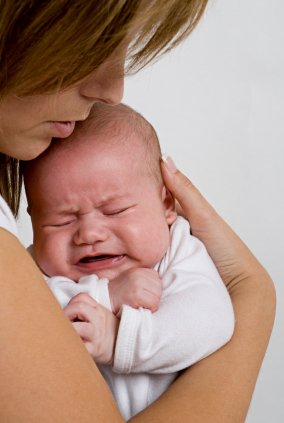
So when you wake up at 3 in the morning to respond to your baby’s cries, you’re building a legacy of secure attachment for her: making her know that she is loved now, and will be forever.

Friday, July 9, 2010

You are what you read?


Back when I was just a wee thing, and my mom was expecting my sister (2 years, 8 months my junior), my parents talked to me about the upcoming, potentially devastating, impact of acquiring a sibling. “I may be jealous” I said (apparently). “Why?” my parents asked. “I read it in a book” was my reply. I was not so precocious as to be reading at that age—but I’m sure someone read me a book about what it was like to have a new baby in the house. It’s a great and simple example of life imitating fiction. We all tend to imitate the stories that read, hear, or watch.

Several of the studies in NurtureShock suggest this in a dramatic way. In “The Sibling Effect,” one bright young boy comments to his mom “..[It’s] just not cool to like a little sister”—something little Ethan seems to have learned from some books. In fact, one researcher on sibling relationships who had given people books and videos to help kids get along, reported parental complaints almost immediately. While the stories given to the families ended on a good note, the bulk of the tales involved a lot of negative interactions. The researcher (Kramer) noted, “From these books, the kids were learning novel ways to be mean to their younger siblings they’d never considered.”

It’s just the tip of the iceberg; the chapter “Plays Well with Others,” (which addresses social interactions and violence among children today) noted another surprising effect: kids who watched shows like Arthur and other educational programming (PBS-type), the more relationally aggressive they were—more aggressive than the group watching Star Wars and Power Rangers in their free time. “What?” you say. Here’s why: “Data from a team at Ithaca College confirms… there is a stunning amount of relational and verbal aggression in kids’ television.” Kids model some of the relational situations they see--which include a lot of negative interaction and socially aggressive behavior.

But there’s a bright side, too! The most interesting example to my mind of the life-imitating-fiction phenomenon was in the chapter “Why Kids Lie.” Most of the chapter addresses the frequency, early onset, and extent of kids’ lying. There aren’t a lot of encouraging signs, though it’s clear that honesty is a valuable lesson to teach, above and beyond simply “not lying.” Getting kids not to lie is often very, very difficult. One thing researchers tried was reading kids stories before asking them questions they thought they would want to lie about. There were two stories: The Boy Who Cried Wolf and George Washington and the Cherry Tree. Contrary to all expectations, the kids who heard the Washington story lied a lot less than the kids who heard the Boy Who Cried Wolf tale. Why?

I’m not going to tell for now…you can just figure it out on your own. I’m running my own little reading experiment!

Monday, June 21, 2010

How to Get Over an Old Flame and Other Strategies of My Former Life Strangely Applicable to My Mommy Reality (aka Crowding Out)


Like I posted previously, there are a lot of things in NurtureShock that got me thinking.One of the chapters I have thought about the most is the one on siblings and why they get along…or not. One of the things that struck me was that the smart money seems to be on the researcher who is focusing on getting kids to have more positive experiences together—not the ones worrying about breaking up their fights and teaching them how to finesse their diplomatic relations. It brings me to one of my general observations of romantic breakups and moving on: it’s hard to get over a guy until there is someone else in the picture. It need not be someone truly feasible…but someone at least to set your sights on. I am shockingly bad at getting rid of old habits, not eating and anything else that smacks of deprivation. But I think my approach may be rooted in some sound principles: it makes a lot more sense to focus on increasing the positive than eliminating the negative. When dieting, I favor consuming large numbers of baby carrots. Sure, they have a lot of sugar in them, but they are *really* good for you. And if you’re full of baby carrots, you’re a lot less likely to eat that whole cheesecake.

So I’m trying to use my insights from the world of food and boys as broadly as possible to see how far I can push it. Now that all my kids are home for the summer, I’m trying my hand on them. Part of it is a question of memory: helping them remember and review the good that’s gone before so that they can (I hope) repeat it more often in the future. I’m not working so much at eliminating the negative as increasing the positive. So, today, when someone actually requested something politely with the right tone of voice, I had her repeat it--several times, to my rapturous oohs and ahhs. When the kids fight, I’m reminding them of all the kind things they’ve done for each other lately. When they fight again (as long as blood isn’t involved), I’m telling them to see if they can come up with a solution in the hopes that they’ll see how they can work together to have more fun, rather than getting stymied every time they disagree.

So far, I think it works. Sometimes. Which in my book, counts as success.

Tuesday, June 8, 2010

Are the Suburbs Really the Root of All Evil?


So there I was, minding my own business, reading our local rag (the Philly Inquirer) at the gym when Aggravation had to strike. An article on the front page of the Health & Science section was called “A Plague on the Young”—just the kind of thing that sparks my jets. The byline reads “A rash of public suicides has left scientists, parents, and school officials searching for answers. Apparently, however, some of the experts involved have figured it all out. To wit: “Shain [Benjamin Shain, previously named in the article who is the head of the division of child and adolescent psychiatry at the Northshore Health System in Evantson, Ill.] blames the advent of the suburbs for the 300 percent increase in suicides between 1950 and 1990. Cities and rural areas had a support system. “But the suburbs, with their white picket fences and only your immediate family at close hand, brought a sense of isolation, a forerunner of suicide.”

OK, so, um, kids are killing themselves because they feel isolated because they live in the suburbs? I definitely see the reasonableness of a connection between feeling isolated/lonely and feelings of desperation, but isn’t there a lot else involved? How ‘bout blaming things on, say, the Internet or the cell phone, which have made it possible to feel ‘connected’ while having none of the normal physical contact that characterizes healthy human relationships? There is a disturbing trend I see around me, especially among intellectuals (especially easy for the childless among them) to see the ‘burbs as a symbol of all that is wrong with the world. The over -simplification of the conversation is absolutely maddening to me. What are we actually talking about when we say “suburbs”? What counts--and doesn't? Are we talking about population density? About the mix (or lack) of commercial and residential property? Or about a type of community, diverse or otherwise?I bring this up especially as Shain is contrasting the 'burbs to both urban and rural environments, obviously very different from one another in many respects, both in the 50s and now.

The whole classification is confusing and vague. I grew up in what is arguably the most urban environment in the U.S.: downtown Manhattan. I had relatives who lived in the “city” of Indianapolis and the “city” of Washington D.C. I put city in quotes because their neighborhoods didn’t feel urban at all to my mind. There were no tall buildings, people had yards, and everyone drove most of the time (my own family didn’t own a car until I was 13 or so). And until I moved to Philadelphia, I thought people liked cities because they could avoid other people more easily; far from seeing cities as community-oriented locales, I saw cities as anonymous areas where people could go out at night without seeing people they already knew and who could choose to say hello to their neighbors or not (the elevator I took up and down from my family’s apartment was not always a very friendly place—our building-mates ran the gamut). And I have lived and visited in suburban areas that resemble cities in their population density and lifestyle in many regards.

When it comes to happiness, I know that I want my children to feel connected to a community; that is something essential for us. I still have a lot of questions about what kind of social environments are best; I imagine many people do. But if we want the conversation to be productive, we need to be a lot clearer about what we’re talking about when we distinguish cities from suburbs. All cities—like all suburbs, towns, and countrysides—are not created equal.

Thursday, May 13, 2010

Like a Lullaby to My Ears: For Happier, Smarter, *and* Thinner Kids, Add Sleep


Whenever I go to the pediatrician's, I pick up all the random handouts they have for parents. Aside from reading all their magazines (and sometimes leaving with them), this is one of my knee-jerk habits. I figure if they have a handout, it’s ‘cause so many parents have asked the same question they figured they needed to. There was a good one, too, titled “Effects of Family Meals, Sleeping and Screen Time on Obesity in Preschoolers”. Basically, the office had synthesized info from the March 2010 issue of Pediatrics' article, “Household Routines and Obesity in U.S. Preschool-Aged Children.” There were three household routines: “regularly eating family meals, getting adequate sleep, and limiting screen-viewing time” that were linked to lowered risk of obesity among children.

Now, this comes close to home for me. My older daughters are in the high end the BMI spectrum, despite pretty good eating habits and bodies that look solid rather than chubby, so I am on the lookout for Good Habits. I am a firm believer in family meals for a whole litany of reasons, both personal and general (I have seen links between family meals and a retinue of desirable consequences, including academic performance); I try to enforce TV limitations strictly (though I don’t eliminate it altogether and we’re in a culture where even limits are hard with screens everywhere you turn). But I love the sleep thing, especially—who’d a thunk it? Getting sleep helps you not be fat? How…affirming! It also taps into the second great chapter of NurtureShock, where the authors document a whole host of amazing (and somewhat disturbing) effects of our children’s loss of sleep. That chapter notes how throughout the country, children get an hour less of sleep than they did a generation ago. The same period has seen tremendous increases in child obesity. While physical activity is important and helpful to children, sleep is also key in keeping their bodies in balance. Children who get more sleep are thinner, as well as happier and smarter. Dr Marc Weissbluth’s Healthy Sleep Habits, Happy Child is particularly useful reading if you’re wondering about that happier thing).

Sleep appears to be hugely important for a whole host of important brain functions, including some that we’re only becoming aware of now. There are regulatory and memory functions that depend on sleep for their completion. Sleep is essential to processing things learned during the day, for example. So “getting a good night’s sleep before a test” is surprisingly sound advice (if only I had realized that in college...)
It’s giving me even more incentive to make sure my kids get some sleep. Maybe with time, I can figure out how to work that out for myself as well….

Monday, May 3, 2010

Could Machiavelli Be Right?


I read Machiavelli’s The Prince as an undergraduate and then again as a grad student; I have taught it a number of times as a part of a college curriculum. While I think Machiavelli is pretty clever, and it’s a great read for tons of reasons (how many manuals do you know that have a place in a liberal-arts program 500 years later?), I have a lot of issues with Machiavelli’s approach. Now most people (a bit boringly, in my troublesome viewpoint) complain about the man’s immorality. But my issues are, firstly, practical. Because Machiavelli is pitching himself as someone who tells brutal truths (he’s an *exceptional* salesman), we buy it. But how well do his prescriptions work? He is hugely inconsistent. Like when he goes on about the value of being feared without being hated. Which is all very well and good—but it’s not always so easy to do so. As a parent, actually, it’s a *bit* easier (though more for my husband than for me), since your kids are much more willing to love you than your average person. But, as I used to point out to my students, it’s not so easy for me to make myself feared by them...without also being despised.

I admit, though, that Machiavelli resonates with many of my smarter students. And there are places where he demonstrates real psychological acuity. One of the most famous bits of his is the whole discussion of whether it’s better to be loved or feared as a prince. It’s often misquoted or misunderstood, but essentially (while BOTH is his preference), Machiavelli concludes that it’s safer to be feared. I have to say that it often troubles me to see how most people are much more motivated by fear than anything. Tell your kids that you have some great stickers if they just manage to sleep the whole night in their own beds and they might do it. Tell them they will lose dessert if they don’t and, miraculously, they don’t leave their room. What a sad fact, thought I. Fear is simply more fundamental to human nature than (positive) desire. How unfortunate.

But recently I’ve found another way to think about it. I’ve read a couple of things lately (The Paradox of Choice and Sway among them), which address loss-aversion on various levels. Essentially, most people will go to great lengths not to lose something they already have. Those lengths are often disproportionate to the actual value we would normally ascribe to that object. While loss aversion isn’t a great thing for a lot of reasons, it does suggest an upside to our fear: we recognize that what we *already* have is tremendously valuable. We naturally hold most dear what is already ours. There is something both profoundly true, and profoundly beautiful to this. With all our competitiveness and envy and what have you, what we value most is what we already have; and we will go to ridiculous lengths to preserve it. So, somewhat ironically, our fear can point to a great source of gratitude. Recognizing that we’re afraid of losing shows us just how very fortunate we are, and how much we have to be grateful for. Our fear reminds us how lucky we are.

So yeah, I guess Machiavelli was right. Sort of.